
Sandy Bay Divers · PADI 5 Star Dive Shop · Roatán, Honduras
The Glow Dive: Roatán's reef after dark
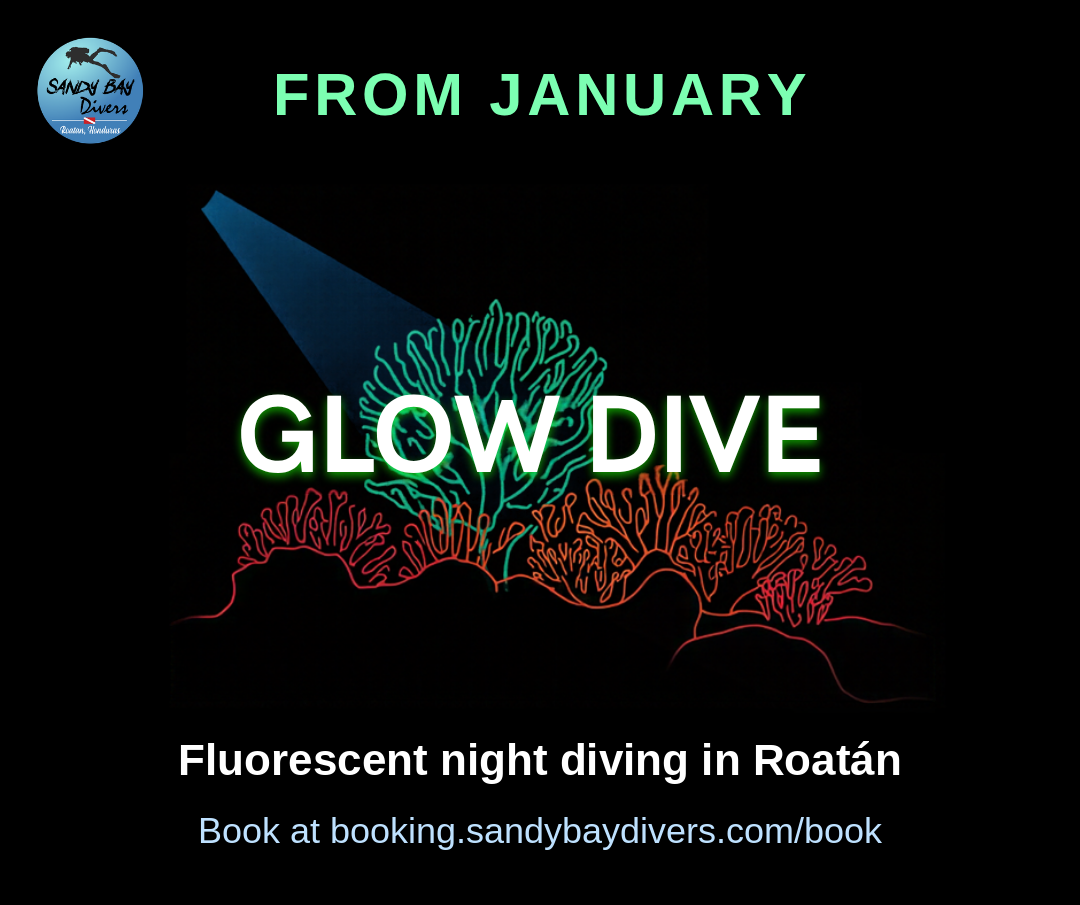
A guided fluorescent night dive from January 2027. Switch on a blue light and the corals and anemones answer back in vivid green, orange and red, against a black reef.
From January 2027 · $100 per diver, tax included · 2 to 4 divers per dive pro
The Glow Dive at a glance
Everything you need to know, in one look
A single guided dive you can add to a trip you have already planned, whether you are coming for the first time or coming home to a reef you know well.
Set up around bookings and demand
Time for coral polyps to fully extend
Tax included. The Marine Park fee is not included and is optional
Per dive pro. The dive runs once two divers are booked
Slow, close and careful, because the best colours are small
At least 20 logged dives including night diving, and good buoyancy
Blue filter on your light or flash, yellow filter on your lens
Bad weather: cancel for free or reschedule. Other cancellations: 12 hours notice.
Fluorescent night diving
What is a glow dive?
A glow dive, also called a fluoro dive, fluorescence dive or UV night dive, is a night dive with a different kind of light. Many corals and anemones, and some other reef animals, carry natural pigments that absorb blue light and give it back as a different colour. That is fluorescence. It happens on the reef all the time, but sunlight and ordinary torches wash it out, so most divers never see it.
On a glow dive we change that. You carry a blue light, and a yellow filter over your mask blocks the blue that bounces back, so only the glowing colours reach your eyes. Despite the "UV" nickname, we use blue light, which makes corals glow more strongly than ultraviolet does. Nothing is added to the reef and nothing is harmed. The animals are simply showing you something they were always doing.
Glow dive or bioluminescence? Bioluminescence is the sparkle plankton makes when you wave your hand in the dark. That is living light. A glow dive is light that you shine on the reef and the reef sends back in a new colour. Both are magic, and a Roatán night can give you a little of each.
We leave one hour after sunset because coral polyps generally take up to an hour after sunset to fully extend their tentacles, which is when the detail is at its best.
What you might see on a Roatán glow dive
Corals and anemones are the stars. Under blue light they can glow in greens, oranges and reds, in colours that look nothing like their daytime selves. You can see right down to the tentacles of the coral polyps as they feed. Some fish glow too, though usually more faintly. Small corals and tiny anemones that blend into the reef by day tend to jump out, so you start noticing things you swam past on every other dive.
Because the filter blocks the normal light, the glow stands out against a black background, like a reef drawn in neon. It is different every time. We will tell you honestly what to look for, but we cannot promise any one animal. What glows on your night depends on the reef, and that is part of the thrill.
And it is still a night dive
Roatán after dark is busy in its own right. Octopus hunt in the open, lobsters and crabs roam, parrotfish sleep tucked inside their mucus bubbles, and basket stars unfurl. Your guide will show you what is out that night.
Your evening
Your Glow Dive, step by step
- Arrive at the shopWe meet at Sandy Bay Divers at Blue Bahia in Sandy Bay shortly before the boat leaves, one hour after sunset. We give you your exact check-in time when we confirm your dive.
- Paperwork and experience checkComplete our usual diver forms and show your certification card and logbook, so we can confirm your Open Water certification, your 20 dives and your night diving experience.
- KitWe sort out your dive gear and hand you the blue light and the yellow filter, and show you how both work before you ever get wet.
- BriefingYour guide covers the site, depth, the maximum dive time of 60 minutes, the route, hand and light signals, how to use the filter, and how to stay off the reef.
- To the boatA short ride out to the site, and your guide goes over the plan once more on the way.
- Into the waterAfter buddy checks we descend with normal dive lights, settle in, and make sure everyone is comfortable in the dark.
- Lights changeOn your guide's signal the white lights go off, the blue lights come on and the yellow filter goes over your mask. The reef lights up. We move slowly and stay close.
- Surface and logA safety stop of at least three minutes at 5 metres (15 feet), then back at the shop we rinse your kit, you log the dive and we talk through what you saw.
Who can join the Glow Dive
- Open Water Diver certification or higher
- At least 20 logged dives, including previous night diving experience
- Good buoyancy control, because the filter limits your view and you will hover close to the coral
No night experience yet? Start with one of our regular night dives, $58 per dive on our price list, the best preparation for a glow dive. Not yet at 20 dives? Our courses and fun dives are the way to get there, and the Glow Dive will be waiting.
Small groups, and what we supply
- One dive pro to a maximum of four divers, so the group stays tight in the dark
- A dive runs once at least two divers are booked
- Up to 60 minutes in the water
- Guide, tank and weights included
- Blue light and yellow filter supplied, so you only bring what you normally dive with
Book
How to request your dive
Glow Dives run when divers book them, and we schedule them around January bookings and demand. Request yours on our booking page in a minute:
- Open the booking page and choose Glow Dive (fluorescent night dive). The calendar opens from 1 January 2027.
- Pick your date and tell us who is diving. Add each diver's certification level and number of dives so we can check everyone meets the requirements.
- We confirm by email. A dive runs once at least two divers are booked on it. If a second diver has not joined, we tell you early and move you to another date.
- You get your exact check-in time. The boat leaves one hour after sunset, so we meet at the shop shortly before.
If bad weather stops the dive, you can cancel for free or move to another date. For other cancellations, our usual 12 hours notice applies, as shown on our price list.
Good to know
Glow Dive questions
Is a glow dive safe?
We apply the same standards as any night dive: a briefing, a guide leading, buddies staying together, and lights for everyone. The yellow filter dims your general view, so we keep the group close, move slowly, and limit each guide to four divers.
Do I need night diving experience?
Yes. We ask for Open Water certification or higher, at least 20 logged dives including previous night diving experience, and good buoyancy control.
What time does the dive leave?
Glow Dives leave one hour after sunset, because coral polyps generally take up to an hour after sunset to fully extend their tentacles. We give you your exact check-in time when we confirm your dive.
When can I book?
Glow Dives start in January 2027. The booking page opens dates from 1 January 2027, and each dive runs once at least two divers are booked.
How much does it cost?
$100 per diver, tax included, with your guide, tank, weights, blue light and yellow filter included. The Marine Park fee is not included and is optional.
Can I touch the glowing corals?
No. We look and do not touch, the same as on every dive. Reef life is delicate, and good buoyancy lets you get close without contact.
Can I bring my camera on a glow dive?
Yes. Photography needs extra filters, a blue filter on your flash or light and a yellow filter on your lens, so an ordinary camera setup will not capture the glow. Tell us when you book that you plan to shoot, so we can talk through your setup.
What if the weather is bad?
You can cancel for free or reschedule to another date.
Why Sandy Bay Divers? We are a PADI 5 Star Resort at Blue Bahia Resort in Sandy Bay, we already run night dives, we keep groups small, and with over 300 named dive sites our guides know how to pick the right spot for the conditions.
Dive with the pros, it's who we are, it's what we do.