
Sandy Bay · Roatán · Free for every diver
The Sandy Bay Divers Reef Guide
See what our guides spotted on the reef this week, look up anything you saw on your dive, and keep a list of every creature you've met in Roatán. It's free, it works on your phone, and our crew updates it after every dive.
- Logged by our crew
- Growing species library
- English & Español
- Feet or metres
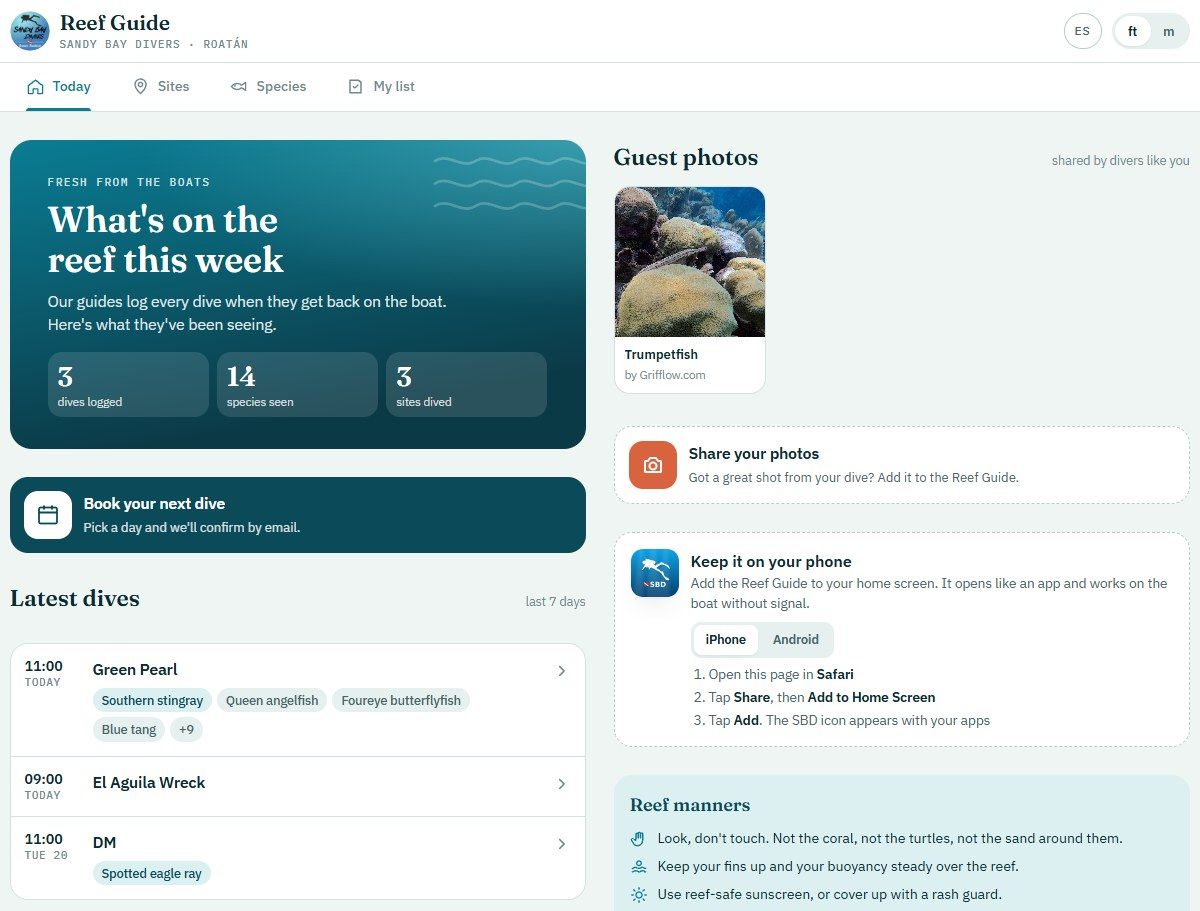
Fresh from the boats
What's on the reef this week
Our guides log every dive when they get back on the boat: the site, the time and everything we saw. The Reef Guide shows those dives as they come in, so before you even get wet you can see which sites we've been diving and what's been showing up.
Turtles at the wall, a stingray in the sand, a lionfish under a ledge: it's the closest thing to asking the crew "what's been out there lately?"
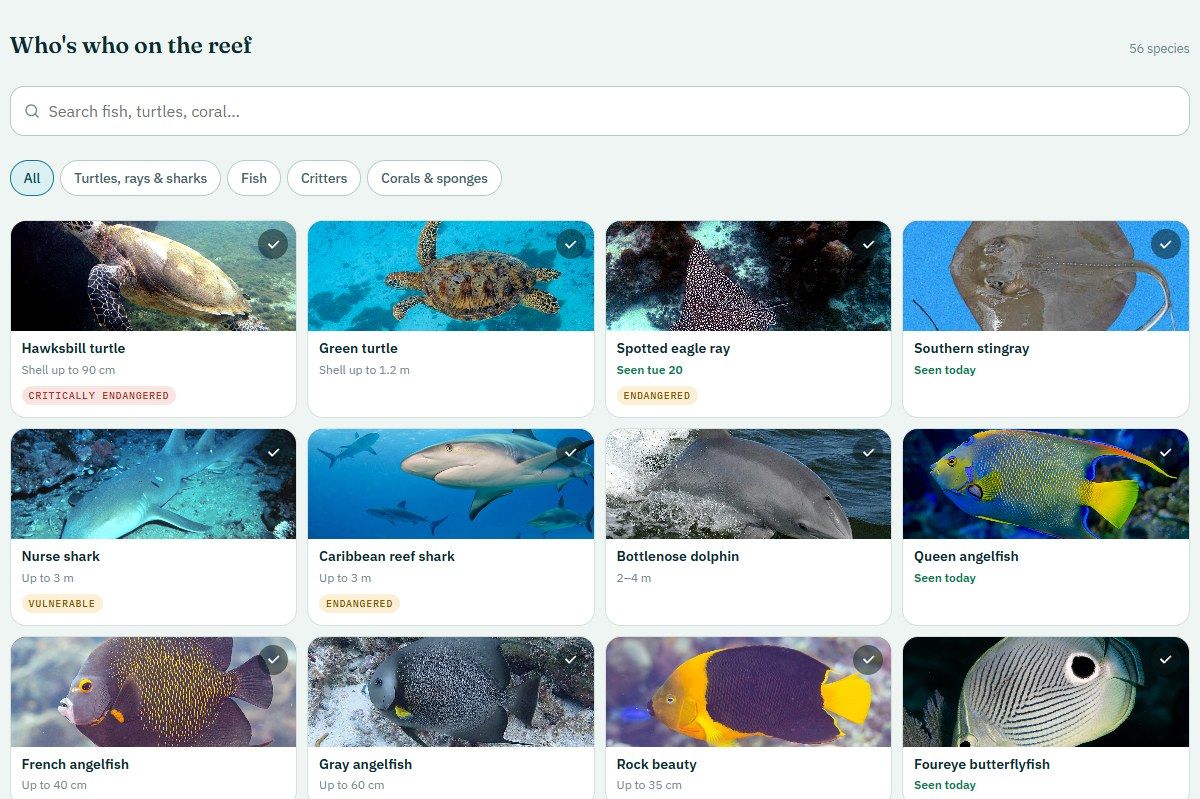
Who's who on the reef
Saw something? Look it up.
Search by name or filter by turtles, rays and sharks, fish, critters, or corals and sponges. Every species has a photo, its size and where on the reef to look for it, with a clear tag if it's endangered, invasive or stings.
The guide keeps growing. When our crew logs something new, it's added, so the more we dive, the more you can look up.
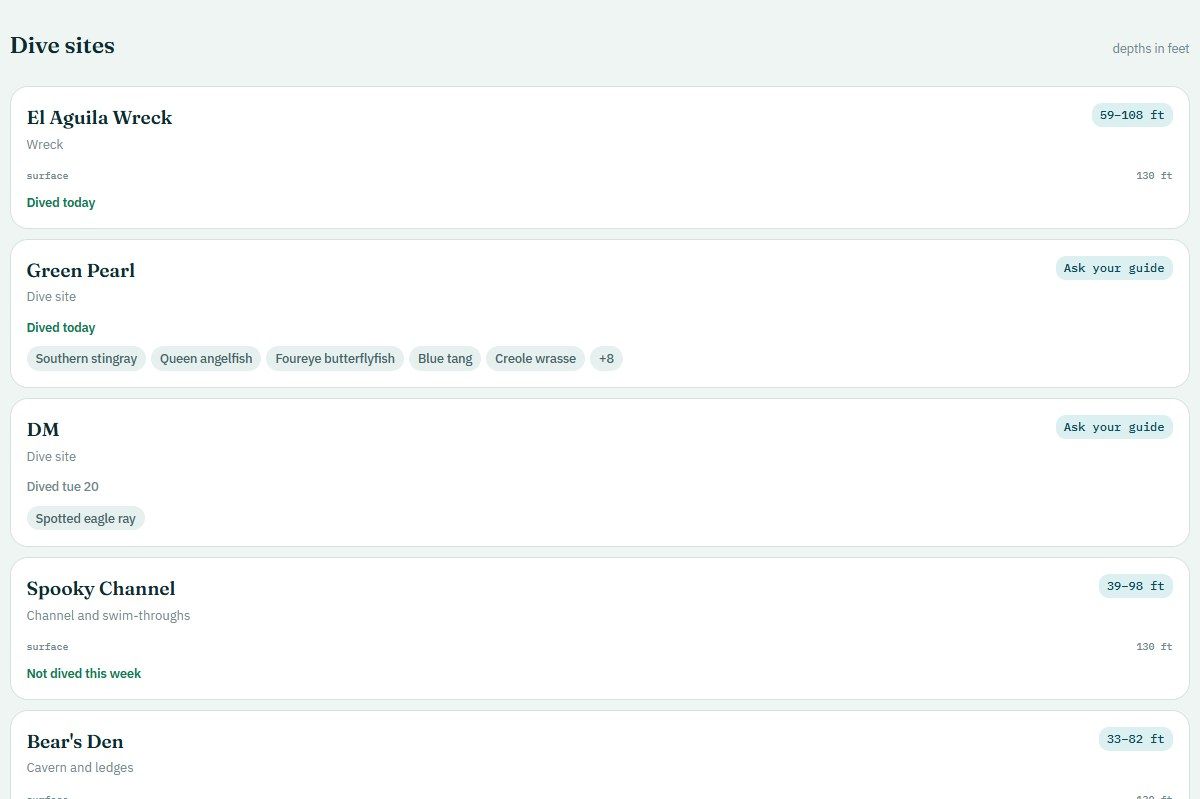
Dive sites
Every site, with what's been seen there
Each dive site shows its depth range in feet or metres, when we last dived it and what turned up. Wrecks, walls, channels and reef gardens, from easy second dives to El Aguila Wreck for advanced divers.
Not sure which suits you? Ask your guide. Picking the right site for the day is what we do.
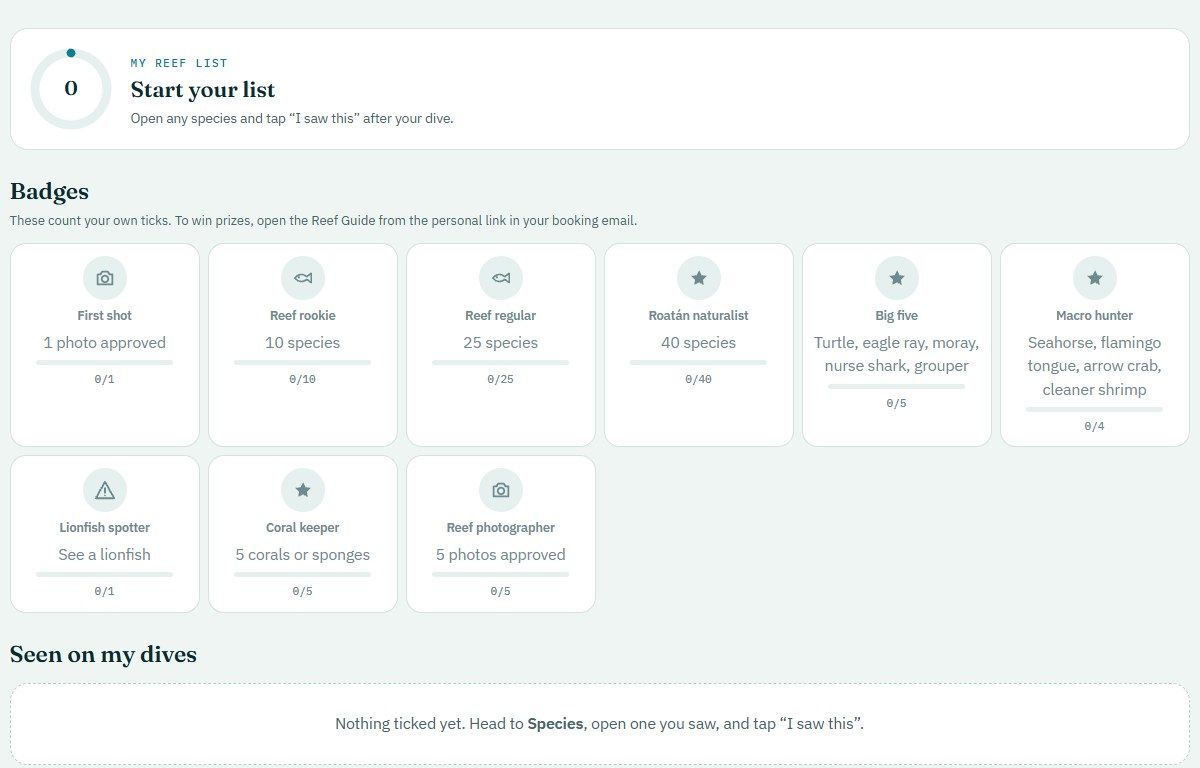
Your reef list
Keep a list. Earn badges.
After a dive, open any species and tap "I saw this" to add it to your list, then watch it grow over your trip.
- Reef rookie, Reef regular, Roatán naturalist: for the species you've seen
- Big five: dolphin, nurse shark, whale shark, hammerhead and Caribbean reef shark
- Macro hunter: seahorse, flamingo tongue, arrow crab and cleaner shrimp
- Reef photographer, Reef photo pro: for your photos we approve for our social media
- Lionfish spotter, Coral keeper and more
Prizes at our front desk* Divers who book with us get a personal Reef Guide link in their booking email. From that link, badges count what your guide logs on your dives and the photos our team approves, and you can collect a prize at the desk.
On your phone
Share your photos. Keep it with you.
Share your photos
Got a great shot from your dive? Add it to the Reef Guide and tag the species. Our team checks every photo before it appears.
Add it to your home screen
iPhone: open the guide in Safari, tap Share, then Add to Home Screen.
Android: open it in Chrome, tap the ⋮ menu, then Add to Home screen.
It opens like an app, even on the boat without signal.
Diving Roatán
What you might see on the reef
Sandy Bay sits inside the Sandy Bay–West End Marine Reserve on the Mesoamerican Barrier Reef, and the reef starts minutes from our dock.
Turtles and rays
Hawksbill turtles, critically endangered and easy to spot by their pointed beak, feed on sponges along the reef. Green turtles graze the seagrass in the shallows, spotted eagle rays cruise the wall and southern stingrays rest on the sand.
Reef fish
Queen and French angelfish, schools of blue tang, stoplight parrotfish, trumpetfish hanging among the sea rods and moray eels peering out of the cracks. And lionfish: beautiful, but invasive here, so tell your guide if you see one.
The small stuff
Slow down for seahorses on the sea rods, flamingo tongue snails on purple sea fans, yellowline arrow crabs and cleaner shrimp on their anemones. Your guide knows where they hide.
Corals and sponges
Brain coral, giant barrel sponges and glowing azure vase sponges, alongside rarer elkhorn and pillar coral, both critically endangered. A good reason to keep your fins up.
Reef manners
Help us keep it this way
- Look, don't touch. Not the coral, not the turtles, not the sand around them.
- Keep your fins up and your buoyancy steady over the reef.
- Use reef-safe sunscreen, or cover up with a rash guard.
- Spot a lionfish? Tell your guide. They're invasive here.
Questions
Reef Guide questions
Is it free?
Yes, for everyone. You don't need to be diving with us to use it.
Do I need to download an app?
No. It opens in your phone's browser. Add it to your home screen if you want it one tap away.
How do I win a badge prize?
Open the Reef Guide from the personal link in your Sandy Bay Divers booking email. From there, badges count what your guide logged on your dives and the photos our team approves. Show your badge at the front desk to collect your prize. Badges from the public guide are just for fun.
Prize terms
- Prizes are for Sandy Bay Divers guests with a booking, using the personal Reef Guide link from their booking email. Badges on the public guide are just for fun.
- Badges count species logged by our crew on your own dives and photos approved by our team. Ticks you add yourself don't count.
- Photo badges count photos shared within 14 days of a dive with us, up to 2 a day. “Reef photographer” and “Reef photo pro” only count photos you've agreed we can use on our social media.
- One prize per badge per guest. Show your badge at the front desk to collect it. Prizes must be redeemed within 12 months of the date the badge was earned.
- Prizes have no cash value and can't be exchanged or transferred. To redeem a free fun dive you must be a certified diver, and to redeem a nitrox fill you must be a certified Enriched Air (Nitrox) diver. Bring your certification card or proof of certification to the front desk. If you're not certified yet, your prize is kept for you to redeem once you are. Free fun dives and nitrox fills are subject to availability and must be booked like any other dive.
- Sandy Bay Divers may refuse a prize if a badge was earned unfairly, and may change or end the badge program at any time. Prizes already earned will still be honored.
Who logs the sightings?
Our own guides, after every dive. Species photos come from Wikimedia Commons and are credited on each species.
Is it in Spanish?
Yes. Tap ES at the top of the guide to switch to Spanish.
Come see it for yourself
Small groups, two boats and three departures a day mean your guide has time to find the critters and show you. Tell us what you'd love to see and we'll pick the site to match.